Case study 02Amura HealthService design
From conversion to commitment: redesigning client onboarding for high LTV alignment
Auditing why the wrong clients were drawn to the program, reframing the pre sale narrative to attract the right ones, then building a diagnostic onboarding framework and structured friction that cuts operational drag and lifts clinical success rates.
- Role
- Service Designer, solo project.
- Duration
- About 60 days: 5 to find, 12 to design, 43 to roll out.
- Scope
- 50 guidance counsellor calls analysed. 34 guidance counsellors and 12 doctors trained.
- Impact
- Between February and June 2026, success rates for the two hardest to serve mindsets rose from 42% to 60% and from 55% to 73%, while their share of clients fell.
- Methods
- Content and narrative audit, marketing and pre sale messaging audit, analysis of 50 guidance counsellor calls, gap analysis, Customer Information form redesign, counsellor and doctor training, structured friction design
A funnel that measured success at the point of payment
Doctors and coaches were overloaded with clients who were not ready for the program, which drove burnout and a wave of post payment escalations.
A client who is willing to pay is a client who is ready to succeed. Onboarding was tuned for conversion, not suitability.
The pre sale narrative was recruiting the two mindsets that later failed, by promising ease to one and reassurance to the other.
I moved the gate from can you pay to are you ready: a reframed narrative, a diagnostic sales call, ten risk categories and a doctor’s call before payment.
What I led and conducted
- The audit of the website, marketing and automated pre sale messages
- Analysis of 50 guidance counsellor calls
- The gap analysis and the redesigned Customer Information form
- The live call checklist and the ten risk categories
- The doctor gate and the effort contract
- Training for 34 guidance counsellors and 12 doctors
Who I worked with
- Guidance counsellors, who run the first call and now fill the new form
- Doctors, who run the call before payment
What changed in the service
- The narrative names the effort instead of promising ease
- Risky leads go through a doctor before they can pay
- Some clients are now turned away by design
The two mindsets that pointed upstream
Case study 01 brought escalations and refunds down. Two mindsets held flat on the metric that decides retention, success. Both were being recruited before they ever reached a sales call, so the fix had to move upstream.
Health as a side task
Fits the program around an unchanged life, so it gets a background slot rather than the priority a result needs.
This program will take care of me
Expects the program to carry the work, so ownership sits with the coach and results trail the rest.
The pattern sits upstream, in who the program attracts. The fix belongs before the client ever enters.
The leaky bucket of high conversion
The program was successfully acquiring users, but the onboarding process was optimised purely for volume, meaning conversion, rather than suitability, meaning retention. Doctors and coaches were overloaded with unready clients, which drove burnout and a wave of post payment escalations.
Shift the onboarding gate from willingness to pay toward readiness to succeed.
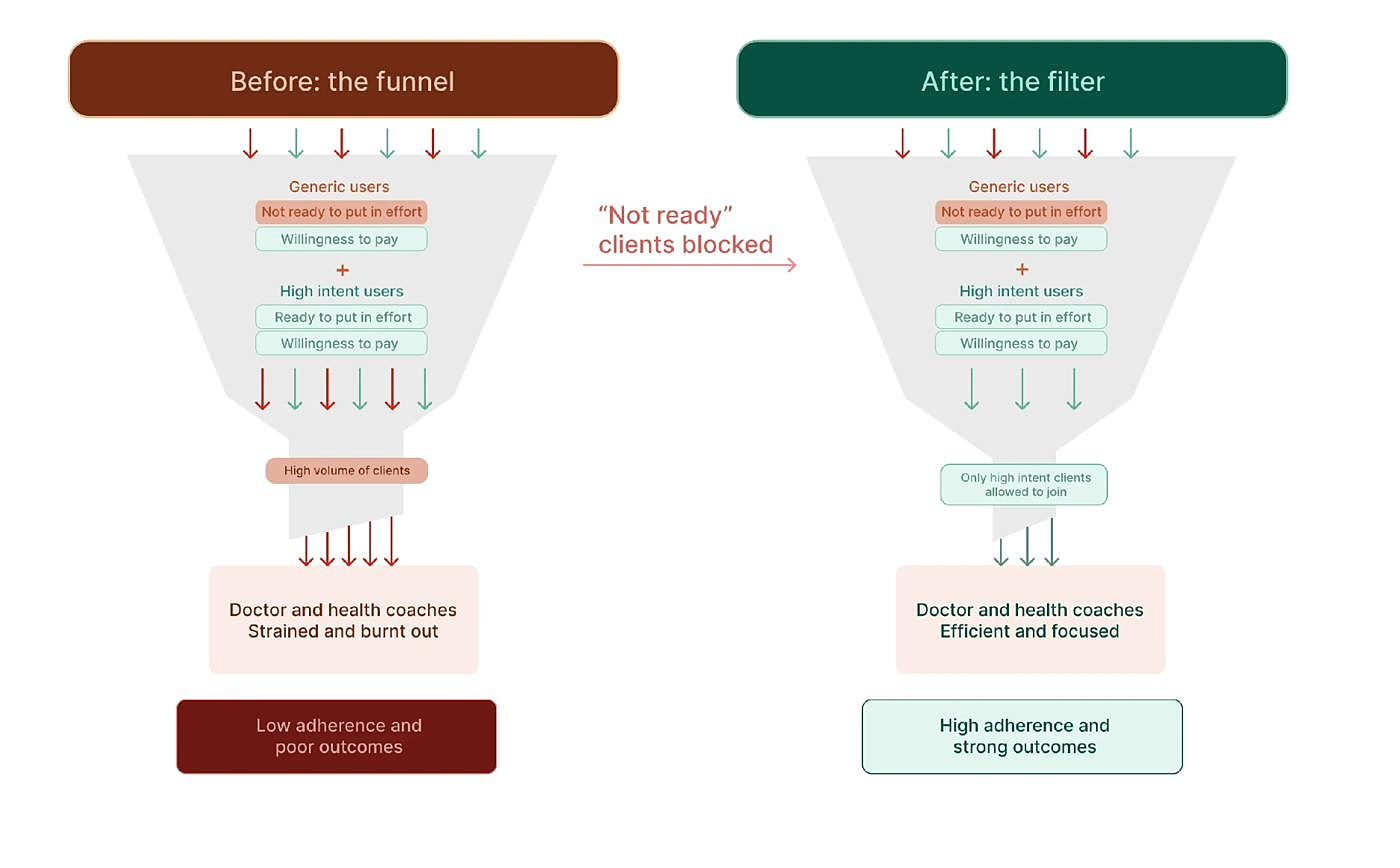
The open question going in: what interventions help clients with misaligned mindsets recognise and adopt the changes needed to actually succeed in the program?
Find, design, roll out
The research and design took under three weeks. Most of the time went into rollout, because a new sales call and a new gate only work if every counsellor and doctor runs them the same way.
- Audit the pre sale assets, analyse 50 guidance counsellor calls and run the gap analysis5 days
- Reframe the narrative, redesign the form, build the ten categories and the checklist12 days
- Train 34 guidance counsellors and 12 doctors, add the gate and the effort contract43 days
Where the mismatch was coming from
Guidance counsellors share only part of the program on a call, yet clients arrive with beliefs that shape how they perform. Where were those beliefs coming from?
I audited the pre sale assets: the website, the marketing and the automated messages. The narrative was recruiting the very mindsets that later failed. Health as a side task came in through the promise of ease, program will take care of me through the promise of reassurance.
- The program is delivered through the app, powered by AI
- The plan is easy and fits effortlessly into daily life
- Design your diet protocol implies the diet is customizable
- A human care team is assigned and delivers real instructions
- The plan requires sustained daily effort from the client
- The diet protocol is fixed and cannot be changed by the client
An effort contract directly on the website, setting expectations before the sales conversation even begins.
This is not a service you consume. It is a contract you enter. Here is what each side is accountable for.
From a clinical profile to a readiness profile
Then I went to the sales call itself. I listened to 50 guidance counsellor recordings, 25 from each failing mindset, then ran a gap analysis on the Customer Information form the counsellor fills. The old form captured a clinical profile. The calls showed that whether a client will succeed lives in four areas beyond it.
Who is the client and what condition do they have?
↓ the calls surfaced four blind spots the new form now captures
Motivation
The real why under the stated goal and what triggered it now.
Context
Work, routine, family, stress and the food environment at home.
Readiness
Willingness and ability to actually follow the protocol.
Support
The kind of coaching wanted and how much ownership taken.
Who is this client, why now, what stopped them before, what is their life, how ready are they and what support do they need?
I redesigned the intake form to capture those signals, the client’s why, their triggers, habit readiness and expectation alignment, so adherence risk shows up before onboarding starts. I standardised its language with the health coach and doctor frameworks so nothing got lost downstream.
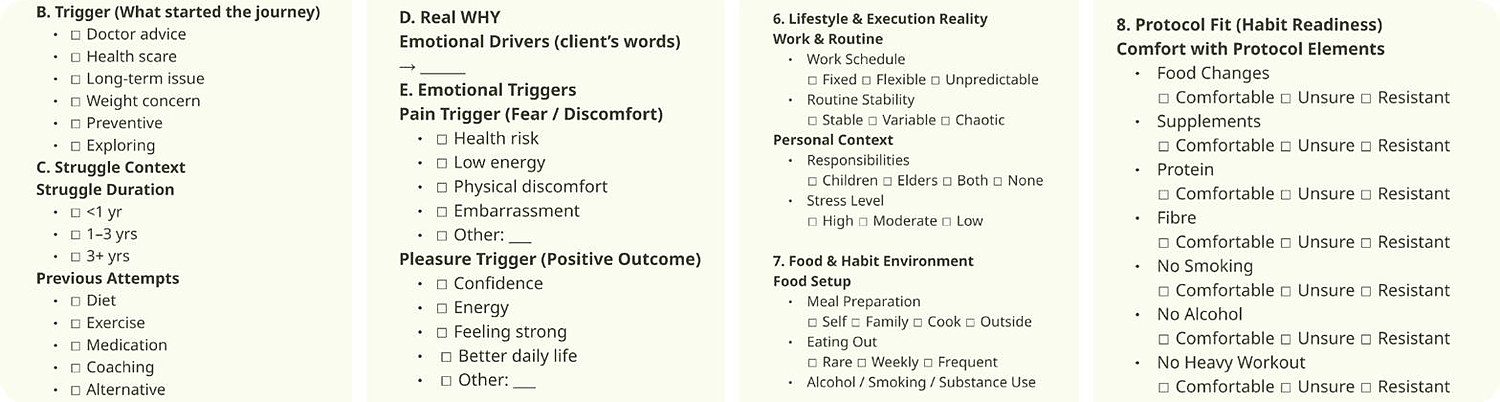
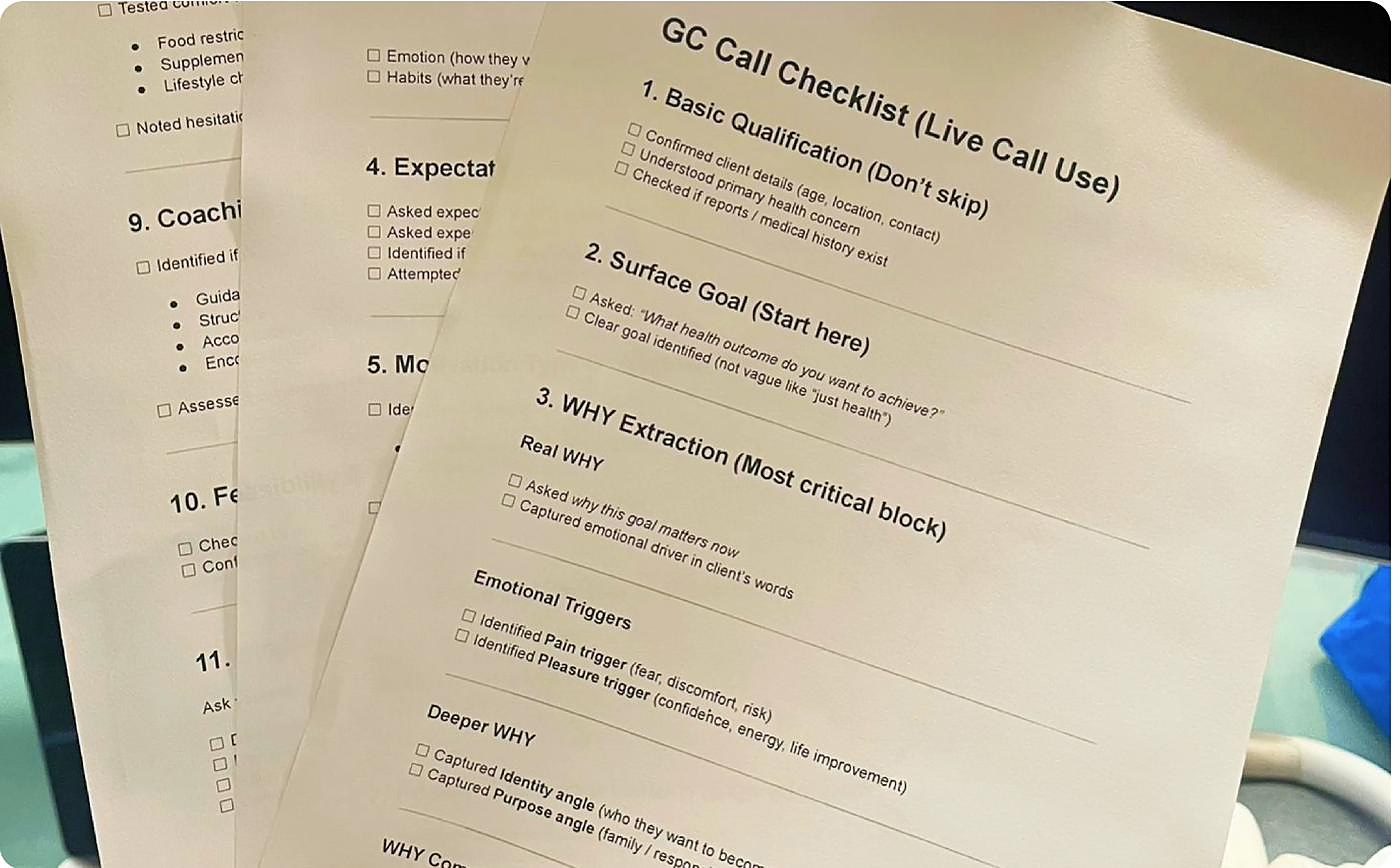
I also built a checklist for the live call, so every first conversation captured the client’s why, expectations and constraints in the same order. The handover to health coaches then started from day zero.
Deciding which clients need a doctor before they pay
I defined ten client categories, each a combination of intake responses, that were most likely to fail the program because of identifiable and addressable gaps. Any match routes the client to a doctor’s call before payment. They group into six areas. Four of them line up with the blind spots in the old form.
01Expectation and effort mismatchClient wants results without proportional effort
- Expectation alignment: slightly unrealistic or unrealistic
- Habit readiness: moderate or low
Prevents future “program not working” escalations
02Timeline distortionUnrealistic expectations about result speed
- Expected results timeline is aggressive
- Health struggle duration of 3+ years
Doctor authority needed to reset biological reality
05Weak why, low internal motivationNo emotional anchor to sustain behaviour
- Emotional drivers vague or missing
- Identity and purpose not selected
- Motivation type: external
High drop off risk after the initial phase
07External trigger dependencyAction driven by fear or an event, not commitment
- Trigger: doctor advice or a health scare
- Motivation type: external
- No deeper why around identity or purpose
Client starts fast but will not sustain
04Lifestyle and program misfitThe execution environment is incompatible
- Routine: chaotic
- Work: unpredictable
- Eating out: frequent
- Travel and events: major
Requires realistic planning before commitment
09High stress with low structureLow cognitive bandwidth for adherence
- Stress: high
- Routine: variable or chaotic
Program may fail without an expectation reset
03High protocol resistanceClient is already negotiating effort
- 3+ unsure or resistant answers in protocol fit, across food, supplements and restrictions
Needs authority to establish the non negotiables
08Behavioural risk: emotional eating with low controlHigh relapse and non compliance risk
- Food pattern: stress or craving driven
- Ownership: medium or low
Needs reframing beyond surface diet compliance
06Medical complexity with high expectationOutcome depends on clinical factors, not just effort
- Multiple conditions
- Aggressive expected results
Only a doctor can set credible boundaries
10Low ownership clientWill depend heavily on the health coach and the system
- Ownership level: low
- Needs: high guidance and reassurance
Risk of dependency and escalation behaviour
The original working table is kept as evidence. Open the source table.
A doctor’s call before payment
I introduced a doctor’s call before payment, using clinical authority to interrupt the instant gratification loop of an impulse purchase. When the payment finally landed, it was an informed commitment, not an impulse buy.
What changed once the filter was live
- Business problemUnready clients overloaded doctors and coaches and escalated after paying.
- Research findingThe narrative recruited the two mindsets most likely to fail. The sales call never checked readiness.
- InterventionA reframed narrative, the effort contract, a diagnostic call and a doctor gate before payment.
- Observed outcomeFewer of those two mindsets entered. More of the ones who did succeeded.
Monthly figures for the whole client base. Share is the proportion of all clients in each mindset that month. Success rate is the proportion of clients in that mindset the program records as successful. February 2026 is the last month before the filter went live in March. April to June are the months after.
Success rateShare of clients
Monthly, February to June 2026
Health as a side task
Program will take care of me
The numbers behind the chart
| Month | Total clients | Health as a side task | Program will take care of me | ||
|---|---|---|---|---|---|
| Share | Success rate | Share | Success rate | ||
| February 2026 (before the filter) | 10,771 | 36.2% | 42% | 16.7% | 55% |
| April 2026 | 10,200 | 31.5% | 50% | 14.5% | 62% |
| May 2026 | 10,650 | 29.0% | 55% | 13.0% | 68% |
| June 2026 | 11,050 | 26.5% | 60% | 11.5% | 73% |
Why it matters for the service: the program grew from 7,190 clients in October to 10,771 by February. When the filter went live, intake dipped to 10,200 as poorer fit clients were turned away, then recovered to 11,050 by June with a better mix.
What this study can and cannot claim
- One month before, three after. February is a single baseline month, so seasonal movement cannot be ruled out.
- Several changes at once. The narrative, the effort contract, the diagnostic call and the doctor gate went live together, so their individual effects cannot be separated.
- A shifting base. Total clients changed month to month, so share and success rate move against a base that is itself moving.
If I were taking this forward
These are proposals, not work that has happened.
Dynamic onboarding pathways.Branching journeys where each of the six mindsets from the behavioral audit receives content addressing its specific fears and biases.
A care team feedback loop.A readiness score doctors can assign after 30 days, to refine the counsellor’s diagnostic script as evidence comes in.
Scaling the doctor as gatekeeper.Evaluating whether the pre payment doctor call can be partly automated, through asynchronous video or AI assisted triage, for lower risk groups.
The strategic value of friction
In high stakes services, good friction is a feature, not a bug.
Slowing down the sale to ensure genuine commitment accelerated long term retention and clinical outcomes, the opposite of what a pure conversion metric would have predicted.